Brian Stovsky – 2022 Velosano Campaign

VeloSano is Cleveland Clinic’s premier fundraising initiative in which 1OO% of all dollars raised are applied to cancer research. Each year, donations raised by Bike to Cure participants, as well as general donations in support of VeloSano, launch new projects with the potential to develop into lifesaving advances in cancer care and cures.

This cause is very important to me and your donation will help me meet my fundraising goal. , Together we will make a significant impact improving cancer outcomes through innovative research.

  • Click the green donate button on my page to make your gift today.

I truly appreciate your support!

Website to donate: https://give.velosano.org/fundraiser/3804651

Brian StovskyOpen Enrollment: Preparing Your Employees To Make Informed Decisions

uly 8, 2022

By Brian Stovsky

Making the right enrollment decision is important – and employees only have one chance per year.

What is Open Enrollment?

Once a year – during open enrollment, employees can sign on to health insurance, make changes to their health insurance or stop their health insurance plan. The only other time an employee would be able to make an enrollment change is if they have a qualifying event, such as a child aging off their parent’s plan (26 years old), marriage (you can add a spouse to the plan), have a child (add the child to a plan), or get divorced. A list of full qualifying events are listed here.

High vs. Low Cost – High Deductible Plans

Most people decide what health insurance plan to enroll in based on the total deducted from their paycheck. For about 80 percent of eligible employees, this can be a decent strategy – the cheaper the plan the better. The rule of thumb is that 80 percent of claims comes from 20 percent of employees enrolled, therefore 80 percent of the employees that are low users of the health insurance typically do not need high-cost benefits. “High-cost” meaning high premium, which usually is associated with lower out of pocket responsibilities (i.e., the plan pays for more).

Getting employees on the proper plan can sometimes be a struggle. Many just reenroll with the same coverage as the previous year without thinking twice. For employees like the low user, companies can use incentives to make a less expensive plan look more attractive by contributing funds to their HSA plan, therefore covering some of their qualified expenses.

For the 20 percent of employees that are moderate, regular, or high users of the health insurance, a mid-deductible and/or low deductible option should be available. Depending on the size of the company, employers can offer a low and a mid-deductible option (typically a $1,000 and a $2,500-$3,000 option). The lowest deductible can be a Preferred Provider Organization (PPO) plan or a narrower network (HMO, EPO, etc.) and the mid-deductible could be a PPO or HSA depending on the deductible level. These options are referred to as silver, gold or platinum plans depending on the richness of benefits.

Employee Education and Support

The process of choosing the right plan can be confusing – especially for first time enrollees – or when there are changes to plan options. Having a team of advisors or staff assist with open enrollment open is important as employees may need guidance to make the right decision. The most common question asked is: “What is my total cost of healthcare?”

Additional questions include:

  • If I choose a cheaper premium option, will I have too much out of pocket expense?
  • If I choose the more expensive option, will my payroll deductions outweigh the cap on my out-of-pocket liability?

All these questions can be answered through group meetings and one-on-one sessions during the open enrollment period. A partnership with your insurance broker is important to employers when designing the right plans for employees – but also important for employees – to provide the service and support they need.

At Oswald, our team comes on-site to meet with employees over the course of 1-3 days (usually) to make sure everyone is comfortable with their decisions and educated throughout the process.


For more information, please visit our Employee Benefits page or contact me directly:

Brian Stovsky
Business Development Leader
216.777.6114
Email

(Source: healthcare.gov)

Note: This communication is for informational purposes only. Although every reasonable effort is made to present current and accurate information, Oswald makes no guarantees of any kind and cannot be held liable for any outdated or incorrect information. View our communications policy.

Brian Stovsky Involved With Empower Sports

https://www.empowersports.org/about

Brian Stovsky is a board member with Empower Sports

OUR MISSION

Empower Sports exists to enrich the lives of athletes of diverse challenges through sports and exercise while promoting kindness, character, and tolerance.

OUR VISION AND VALUES

We believe that every athlete should have an opportunity to participate in the games they love. 

Sports have the power to bring us together and forge new friendships.

Sports can foster greater empathy between people of diverse abilities and backgrounds.

We are driven to provide programs so that no one is left out.


GET TO KNOW US

Empower Sports is a 501(c)3 nonprofit organization committed to providing sports and exercise programs for children and adults with various physical and cognitive disabilities and additional programs for typically-developing kids. We value diversity, relationships, service, and empathy.

To put it simply, we are sports junkies. We grew up playing the games we love, and now as dedicated professionals we are working to provide those opportunities to those in need while fostering relationships between individuals of diverse backgrounds.

Programs emphasize socialization skills, self-esteem, teamwork, discipline and (most importantly) HAVING FUN!

HISTORY

Empower Sports was founded with the belief that no athlete should ever be left on the sidelines, regardless of disability, age, or gender.  So when we kicked off our first ever basketball clinic in November of 2012 we welcomed ALL interested players with the mindset of tailoring the program to meet our players at their needs.  The result was a beautifully diverse group of players and volunteers enjoying time together in the gym.

Since then, our program has evolved to include softball, soccer, lacrosse, fitness classes, and a lot more basketball! Through our basketball and softball team sport initiative we bring groups of our favorite athletes together with volunteer teams to play. Intermixing the teams allows our players to play right alongside of their typically-functioning peers. It’s all about building socialization skills, self-esteem, and getting some exercise together!

https://www.empowersports.org/about

Brian Stovsky Offers These Tips For Recent Business Graduates Looking to Further Their Career 

Brian Stovsky Offers These Tips For Recent Business Graduates Looking to Further Their Career

Finding a job and advancing your career takes a lot of work. Brian Stovsky provides advice.

Looking to start your business career on solid footing? While careers in business can be rewarding and the right degrees can open a lot of doors, the right steps early in your career may help ensure success later on. Fortunately, business expert Brian Stovsky is going to offer some sage insights.

“The most important thing after university, in my opinion, is to keep an open mind,” Brian Stovsky says. “Sometimes, the best opportunities pop up in unexpected places. By staying flexible, you can identify great opportunities, and perhaps chances others miss.”

As the end of your university program approaches, it’s wise to start doing market research to understand where the greatest needs are. Already out of school? Don’t worry, market research still pays off. If you can find areas where your skills are in demand, not only might you land a great job, but you may pave the way for fast promotions.

Right now, for example, cybersecurity experts are in demand owing to pipeline hacks, foreign government intrusions, ransomware, and other issues. Do you have any skills that allow you to increase cybersecurity?

Rather than focusing on a specific role, it’s wise to keep an open mind and to search around. By identifying what businesses need and where critical shortages are, you can figure out how to best position your skills.

“I worked for one of the top business consulting firms in the world, and later I worked in investing,” Brian Stovsky points out. “In both cases, I first identified critical needs. Then I positioned myself to help meet those needs.”

If you’re having trouble opening doors, consider spending some volunteering or tapping into other opportunities to meet people and show off your skills. Networking is key to furthering your career. However, networking isn’t limited to conferences and business happy hours.

“I’ve volunteered with various organizations and events over the years, and it helped me meet people,” Brian Stovsky says. “I also play in a local hockey league, and that helps me meet people as well. I don’t necessarily go into these activities looking to make connections, but the more people you meet, the more connections you make.”

Brian Stovsky Discusses Stand Out Performance At Work

Once you’ve landed a job, the work has just begun. If you want to advance, you need to show off your skills and highlight your talent while also creating meaningful personal relationships.

“I always work hard to maintain good relationships with the people I work with,” Brian Stovsky says. “I also take on problem projects that some people shy away from. It’s a lot of work, but if you can successfully solve challenges, you can show off your skills and make a great contribution to your company.”

A Fresh Look: How Health Insurance and Plan Choices Can be Key for Retention and Controlling Costs 

https://www.oswaldcompanies.com/media-center/a-fresh-look-how-health-insurance-and-plan-choices-can-be-key-for-retention-and-controlling-costs/

June 6, 2022

Image
Image

By Brian Stovsky

Employee benefits have become a key part of the hiring and retention of employees in today’s hiring market. There is more stress on compensation now more than ever as demand for higher salaries and pay rates come from potential hires and the existing workforce.

An employer’s willingness to put the time and effort into their employee’s benefits outside of wages may make the difference. At a high level, total compensation and employee benefits includes, but is not limited to, health insurance, wellness programs, life insurance and retirement or defined benefit plans.

As a Private Equity investor, what can I do to leverage my portfolio to drive down risk and cost?

As a private equity fund, independent sponsor, individual buyer, family office, mezzanine investor or another type of investor, common ownership can be leveraged in the purchasing of health insurance. 

If you are a common owner of a portfolio of businesses or a private equity (PE) investor – taking a close look at your employee health insurance strategy overall can drive down your risk and costs.

It is important to leverage the volume (population) of the entire portfolio, stratify your claims risk across more employees and hence, reduce your overall cost.  This approach of building a portfolio health insurance “program” takes on a more macro-view of health insurance and can be extremely beneficial to investors. 

Taking on this strategy creates many benefits for a portfolio, among which are the following:

  • All of the portfolio companies can be viewed under a single microscope: which allows the PE buyer to see where costs are increasing and where opportunity lies more clearly among the portfolio.
  • Budgeting can be done across the entire portfolio:  Rather than wondering what renewals 10 different carriers will hand out in a given year, limiting the number of carriers to a smaller consistent group will allow the Private Equity Group (PEG) to project costs with more accuracy. 
  • Eligible and enrolled lives on the plans increases with the volume of the portfolio: Typically, underwriters view companies in terms of people enrolled in the medical plan.  Companies are either <100 enrolled or >100 enrolled.  Less than 100 enrolled companies only have access to state-filed rates, the companies do not gain access to their claims data, customized plans or have (any) negotiating power.  Greater than 100 enrolled is the opposite, plans can be customized, and rates can be negotiated largely because claims data is available to the Company. 
    • Having five 20 enrolled companies with different carriers compared to a commonly owned group of 100 enrolled with a single carrier can create a material difference in cost.

How Does It Work?

Historically, portfolio programs were “risk pools,” creating a single fully-insured plan (or group of plan options) that all of the portfolio companies would feed into.  Essentially PEG would have PEG Health Plan and portfolio company (portco) 1, 2, 3, 4…..etc. would all be members of that plan.  Although this can be an effective approach, the trouble lies at exit.  If portco 1 is a member of PEG Plan, when they are sold that portco must now become the plan sponsor of a new plan – the pool does not transfer with the selling entity post-closing.  Therefore, the portco’s plan costs will inevitably increase upon exit as they do not have the support of the pool. 

We have adapted to this issue and created more of an “umbrella” approach. Placing the PEG and their portfolio companies under a single carrier (or small group of carriers) will create a block of business or an umbrella, however the individual portcos will be their own plan sponsors from the start – not under a single plan sponsor.  Therefore, the volume of the block of business can be leveraged during underwriting – however, upon exit the portco will assume the same plan they had pre-closing.  This creates a much cleaner exit.  Additionally, if a portfolio company would benefit from self-insuring rather than fully-insuring, this gives the PEG the flexibility to move portcos in an out of the block without throwing off the pool. 

Most Private Equity clients of ours steer away from self-insuring given the risk of run-out claims after exit.  When I portfolio company exits the portfolio, it is important to most investors that there is a clean break, with no risk of future liability from past or future claims.  There is a possibility of claims run-out when self-insuring a portfolio company if a transaction occurs before the end of the plan year. 

However, that does not mean self-insurance should be shunned forever in the world of PE.  If the PEG has a general idea of the holding period of a specific group and they meet the size criteria for a self-insured group, self-insurance has its benefits and can be a major cost-reducer.  Additionally, with self-insurance the opportunity for captives comes into play – a much more popular option in recent years as health insurance cost trends seem to exponentially increase. Captives are a larger pool of similar risk companies that are self-insuring while stratifying their risk over the entire captive.  Captive programs enable employers to combine employees claims experience with other like-minded businesses to control medical insurance costs

If you are an owner of a portfolio of businesses or a private equity (PE) investor and want to investigate your options to provide your portfolio with the least amount of risk and most cost benefit, Oswald’s Private Equity Team has expertise in the area of health insurance/employee benefits.  We work with our clients to make informed decisions and create an individualized plan that is backed by data, analysis and market information. We serve over 2,000 clients nationally and are among the largest privately held, employee-owned and independent brokerages in the country. 

For more information on alternative risk and captives – https://www.oswaldcompanies.com/risk-hubs/alternative-risk-captives-and-programs

For more information on employee benefits – https://www.oswaldcompanies.com/employee-benefits/

Brian Stovsky is Business Development Leader, Private Equity, Oswald Companies

Taking control of the cost of insurance

Insurance is all about the balance of cost and risk.  If I know where my risk lies, then I can better control my costs.  This principle is the foundation of how to view your health insurance strategy. 

Many advisors focus on the market to control costs.  This approach can yield some results – the health insurance marketplace is highly competitive and cost reductions can be achieved by leveraging carriers against one another – however, these results are short-term and are often outweighed by bounce-back increases (often referred to as the “whiplash effect”).  Typically, one in every five years will be a “bad” claims year for a company and incur a larger increase for the next renewal.

There are numerous other strategies to consider when trying to take control of your insurance costs.  The most obvious of which is by focusing on your own employees.  Healthier people with the appropriate amount of insurance tends to flatten out the increasing health insurance cost trend.  Healthier people lead to lower claims; lower claims lead to a lower loss ratio (Claims/Premium); lower loss ratios lead to lower renewals. 

How do I make my population healthier? 

Employee incentive programs through compensation and benefits can be a great part of this strategy.  Providing employees with incentives such as reduction in payroll deductions for health insurance or gift cards for

  • completing wellness initiatives (i.e. annual physicals, step challenges, etc.)
  • quitting smoking/tobacco products, or
  • other offerings

It is a relatively easy way to start that journey towards healthy living.  It will give employees short-term relief by reducing how much they pay for insurance, or excitement and team building surrounding an employee challenge –  and the end result is the Company has longer-term relief in the reduction of future claims. 

Here is an example:  If an employee controls high blood pressure earlier because the issue was found during an annual physical, a future heart attack may be avoided.  Heart attacks can turn into a six or seven digit claim that a Company would absorb through higher premium payments, which could have been avoided through medical maintenance.  Controlling costs outside of the market conditions.

Two tools to help you with these initiatives  

You do not need to go down this path unprepared.  Two primary tools come to mind. 

Carrier Resources:  Believe it or not, health insurance carriers want lower claims too. While a fully insured Company may absorb claims through future premium increases, the carriers need to front the bill.  High claims are not always profitable for carriers (which are businesses too….large ones at that) and they will look for ways to lower claims and improve population health.  Most carriers have an arsenal of resources available to their subscribers (employees enrolled), that are unknown to the users. In some cases, carrier mobile apps are built with A.I. to give tips to users based on their health history, medical and prescription claims data.  Additionally, in leu of premium reductions, many carriers offer wellness dollars for their clients to pay for wellness initiatives (i.e. fitbits, wellness vendors, and wellness technology).  All you need to do is ask.

Broker/Advisor Resources:  Brokers are the intermediary between the Company and the carriers; an advocate for their clients.  In addition to being able to obtain credits for wellness many brokers have access to resources of their own through broker/vendor relationships.  Oswald, for instance, has a longstanding relationship with PeopleOne Health – our primary wellness consultant group.  At minimal cost, our teams will come onsite and perform wellness consultations, host wellness fairs, introduce wellness challenges and offer technology to track the status of employees’ wellness initiatives. 

A look at insurance funding

Another strategy is centered around how the insurance is funded.  If I am willing to take on more risk on the front end, there may be more upside but also more liability.  It may be considered a gamble, but by knowing my population, I am more comfortable around the potential outcomes. 

The two main types of insurance funding are fully insured and self-insured.  Fully insured is when the Company pays the carrier higher premiums up front and, in return, the carrier offers access to their network, takes on full responsibility of the payment for claims, administration of claims and retention costs.  Increases or decreases in cost mainly come in the form of annual renewals, based on loss ratio.

Self-insured is a little bit more complicated.  At its core, self-insuring is when the Company will take on the responsibility of claims up to a specific dollar amount (per person) and pay a third-party administrator to administer the claims, provide a maximum annual spend limit and pay a carrier for access to their network.  In these cases, the Company is assuming more of the claims risk (betting on themselves), paying lower premiums but taking on the burden of claims payment. Typically, groups with under 100 employees enrolled will veer away from self-insuring as the risk pool of employees is too small to justify taking on the risk of claims.  A handful of high claimants can have too detrimental of an impact to the risk pool as a whole.  As the group grows in size, self-insurance can become a more viable option.

In recent years, middle ground solutions have come to light.  For instance, buying a higher deductible fully-insured plan where the Company covers a portion of the employee’s deductible through a Health Reimbursement Arrangement (HRA).  This strategy offers the Company a way to bet on themselves somewhat, but taking on part of the deductible liability, while still maintaining a fully-insured plan and capping their risk.  The higher deductible offers a lower premium option as well, going back to the theme of if I take on more risk, my upfront costs can go down.  Of course in this case – those strategies to keep your employees healthy will certainly be a bonus.

All these choices can be overwhelming to a Company – but it doesn’t have to be. Oswald has expertise in the areas of health insurance/employee benefits.  We work with our clients to make informed decisions that can be tough at times – but are backed by data, analysis and market information. We serve over 2,000 clients nationally and are among the largest privately held, employee-owned and independent brokerages in the country. 

For more information on employee benefits – https://www.oswaldcompanies.com/employee-benefits/

Brian Stovsky is Business Development Leader, Private Equity, Oswald Companies


Open enrollment?  How To Help Your Employees Make the Right Decisions

Making the right enrollment decision is important – and employees only have one chance per year

Open enrollment

What is open enrollment?

Once a year – during open enrollment, employees can sign on to health insurance, make changes to their health insurance or stop their health insurance plan.   The only other time an employee would be able to make an enrollment change is if they have a qualifying event, such as a child aging off their parent’s plan (26 years old), marriage (you can add a spouse to the plan), have a child (add the child to a plan), get divorced, or your spouse passes away. 

A list of full qualifying events is listed here: https://www.healthcare.gov/glossary/qualifying-life-event/

High cost vs. Low Cost – High Deductible Plans

There are usually many options to choose from.  Most people decide what health insurance plan to enroll in based on what comes out of their paycheck.  For about 80% of eligible employees, this can be a decent strategy – cheaper the plan the better.  The rule of thumb is that 80% of claims comes from 20% of employees enrolled, therefore 80% of the employees that are low users of the health insurance typically do not need high-cost benefits.  “High-cost” meaning high premium, which usually is associated with lower out of pocket responsibilities (i.e. the plan pays for more). 

Getting these employees on the proper plan can sometimes be a struggle.  Many employees just enroll in what they were already enrolled in previously without thinking twice.  For employees like the low user, companies can incentivize employees to join the cheaper plan by contributing some money to their Health Savings Account (HSA) plan or covering some of their qualified expenses.

For the 20% of employees that are moderate, regular or high users of the health insurance, a mid-deductible and/or low deductible option should be available to the employees.  Depending on the size of the company, employers can offer a low and a mid-deductible option (typically a $1,000 and a $2,500-$3,000 option).  The lowest deductible can be a Preferred Provider Organization (PPO) plan or a narrower network (HMO, EPO, etc.) and the mid-deductible could be a PPO or HSA depending on the deductible level.  These options are referred to as silver, gold or platinum plans depending on the richness of benefits.

Employee education and support

The process of choosing the right plan is confusing – especially for first time enrollees – or when there are changes to plan options.  Having open enrollment staffing is important.   Employees may need to be walked through the math to make the right decision.  The most common question asked is: “What is my total cost of healthcare?” Additional questions include:

  • If I choose a cheaper premium option, will I have too much out of pocket expense? 
  • If I choose the more expensive option, will my payroll deductions outweigh the cap on my out-of-pocket liability? 

All these questions are answered through group meetings and one-on-one sessions during the open enrollment period.  A partnership with your insurance broker is important to employers when designing the right plans for employees – but also important for employees – to provide the service and support they need during this time.  

The Oswald Company teams come on-site to meet with employees over the course of 1-3 days (usually) and make sure everyone is comfortable with their decisions and educated throughout the process.

More information on choosing plans: https://www.healthcare.gov/choose-a-plan/your-total-costs/

For more information Oswald Companies’ Employee Benefits – Employee Benefits and Health Insurance Solutions (oswaldcompanies.com)

Brian Stovsky is Business Development Leader, Private Equity, Oswald Companies

Recruitment, Retainment and Employee Benefits

Employee benefits have become a key part of the hiring and retention of employees in today’s hiring market.  There is more stress on compensation now more than ever as demand for higher salaries and pay rates comes equally from potential hires as it does from the existing workforce.

An employer’s willingness to put the time and effort into their employees benefits outside of wages may make the difference.  At a high level, total compensation and employee benefits includes, but is not limited to, health insurance, wellness programs, life insurance and retirement or defined benefit plans. 

Health Insurance

More specifically, health insurance can provide employees compensation in the form of reducing out of pocket exposure when it comes to their healthcare needs and access to their providers. 

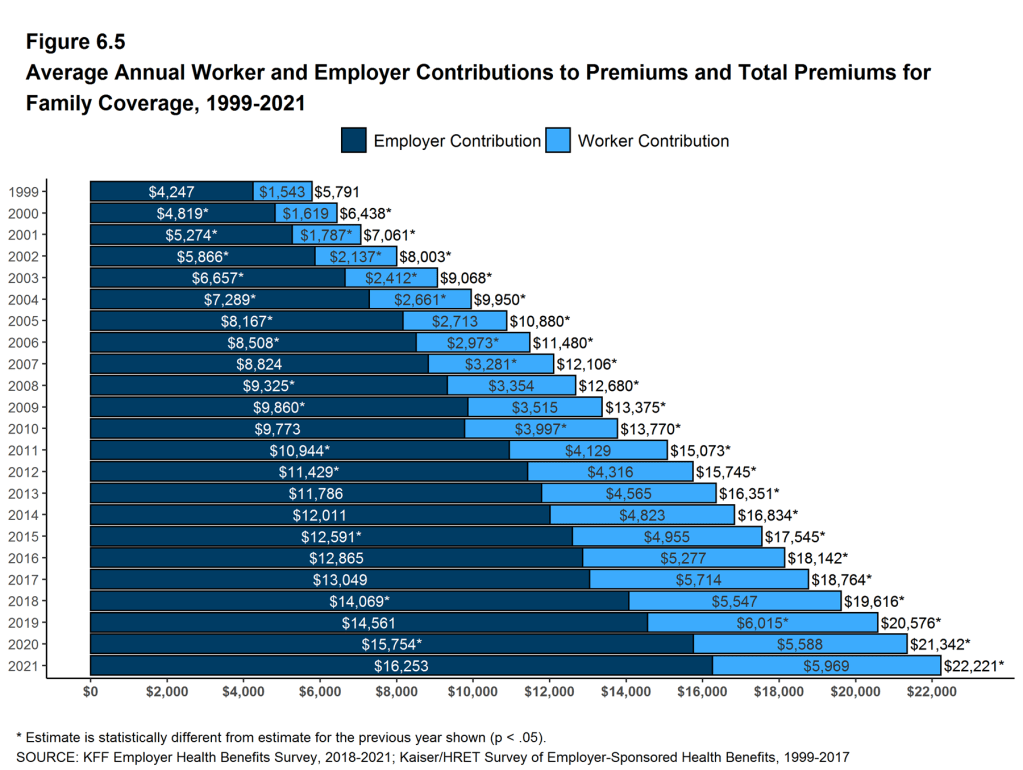
Health insurance typically accounts for one of the largest P&L expenses for an employer outside of payroll.  Typically there is a cost share for this expense (the insurance premium) between the employees and the employer.  Benchmark data from the Kaiser Family Foundation (KFF) stated that in 2020 the average employer share of this expense fell between 60-70%, leaving the employees with ~30%-40% of the premium responsibility deducted out of their payroll.  2021 KFF findings here: https://www.kff.org/health-costs/. Companies could argue that they are essentially compensating their employees by covering a larger percentage of their healthcare premium on top of what they pay them through payroll.

However, these figures have shifted somewhat throughout the pandemic.  As companies have found it more difficult to create higher payroll some have decided to take on more of the premium burden, leaving their employees with more of their payroll to spend on other things such as living expenses.  However, as we have come out on the other side of the pandemic (somewhat), health insurance premiums have gone up significantly – raising more than 7% on average year-over-year from 2021-2022 which renewal increases reaching 30-40% in some cases that we’ve seen.  This has created cost share shift in the opposite direction, resulting in employers deducting more out of payroll to accommodate the increases.

These renewal increases our driven by a couple primary factors.  The first is that during the pandemic, many “non-essential” procedures (or non-emergency procedures) were delayed as providers did not have the capacity to perform such procedures during the height of COVID-19.  The result was that claims for companies went down substantially therefore smaller premium increases were given by health insurance underwriters during the 2021 renewal season.  However, going into 2022, underwriters took on a much more conservative outlook – knowing that claims would rebound and increase as many procedures users could not do in the previous year would occur during this year. 

The receipt of such unfavorable increases has driven companies to reconsider the plans they provide their employees.  PPO plans offer broader network, copays for doctor’s visits (primary care) as well as specialists covered under the network and prescriptions.  HSA plans are high deductible health plans (HDHP: exceeding $1,400 for individual deductible and $2,800 in family deductible) and require the user to cover the deductible expense out of pocket before the plan contributes to the healthcare expenses at a coinsurance.  PPO plans typically charge higher premiums but require less out of pocket expenses because of their copay structure.  HSA plans typically charge less premium but require more up front out of pocket expense to reach the deducitble limit.  Additionally, they offer the user a tax-free way to put aside money for qualified medical expenses, defined by the plan.   

When faced with such material increases, companies look to transition to plans with cheaper premiums – i.e. higher deductibles, more narrow networks, etc. to migrate their employees to plans that may create a lesser expense for the company.  However, employers often overlook the headache that such a change may cause for their employees.  For instance, if you are an employee used to paying a $30 copay for a doctor’s visit under a PPO plan, but now has to foot the entirety of the doctor’s visit bill until you reach your deductible under an HSA plan – that may cause some stress.  Further, if an employer moves to a narrower (smaller) network to reduce premium which causes a major local hospital system to be considered out-of-network and not covered by the plan, and HR director will be facing some tough conversations with employees. 

These changes, which seem like the right thing to do on the surface, cause more employees to seek other places of employment.  Even more so than higher wages.  This is why the decisions must be carefully made and analyzed before finalized.  The use of an experienced insurance broker will help do just that.

Many HR professionals have experience with their own population of employees, payroll and benefits at some level.  However, the broadness of experience dealing with different health insurance carriers, networks, plans, benchmarks, etc. requires the use of an objective third-party with a breadth of employee benefits knowledge. 

For over 130-years Oswald has done just that, provided expertise in the areas of health insurance/employee benefits, commercial P&C insurance, life insurance and retirement plans to our clients.  We work with our clients to make informed decisions that can be tough at times – but are backed by data, analysis and market information. We serve over 2,000 clients nationally and are among the largest privately held, employee-owned and independent brokerages in the country. 

By partnering with a broker such as Oswald, not only is the company getting the advice that they need to make decisions at the leadership level, but employees are also getting the assistance they need from a service team to enroll in the right plan. 

Brian Stovsky is Business Development Leader, Private Equity, Oswald Companies